

The Paradox of Progress: Blockchain’s Real Breakthrough Lies in Its Limitations | Opinion

Imagine a world where every country had its own internet — one for the US, one for Germany, and one for Japan — but none of them could connect to each other. Emails wouldn’t be able to cross borders, social media would be restricted to countries, and global commerce would be an expensive dream, confined to walled gardens. That’s the state of blockchain today.
A Revolution Is No Longer About Scale
Technological revolutions always start with trying to overcome existing limitations. With blockchain, this often revolves around faster, cheaper transactions and greater scalability. However, history shows us a different path. Innovation rarely follows a linear path. Technologies don’t simply expand, they redefine the limits that hold them back.
Take the internet. Its early years were dominated by closed ecosystems — like AOL, CompuServe, or Microsoft Network. Each ecosystem tried to preserve value by limiting interoperability. However, as open protocols (HTTP, SMTP, TCP/IP) emerged, these closed ecosystems began to collapse, ushering in an era of global connectivity. The internet didn’t succeed because it removed friction, but because it redefined how systems communicate.
Blockchains are now at a similar crossroads. The obsession with scalability has led to fragmentation — with solutions like rollups, sidechains, and alternative Layer-1 blockchains — each solving a separate problem while adding complexity to the ecosystem as a whole. But in that race to scale, we’ve lost sight of one crucial element: connectivity.
Key Barriers: User Experience and Fragmentation
The current blockchain space is becoming a collection of walled gardens, and this has led to a number of notable consequences:
- Poor user experience: Moving assets from Ethereum to Solana, from Bitcoin to Cosmos, is like trying to assemble an IKEA furniture set without instructions — possible but painful.
- Limited innovation: Developers create great applications, but many only work on a single chain, limiting their user base and growth potential.
- Fragmented liquidity: DeFi applications struggle to work across multiple chains, and liquidity is fragmented. Users have to jump between multiple wallets to make simple transactions, which often leads people to stick with the safest ecosystem they are familiar with.
The Future of Blockchain is Interoperability
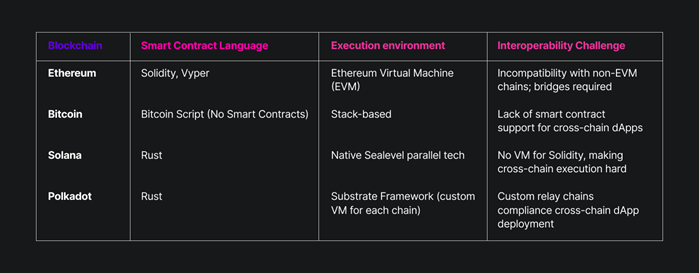
According to Electric Capital’s 2024 report, there will be over 120 Layer-1 blockchains and dozens of different Layer-2 solutions. Each blockchain has its own consensus mechanism, execution environment, and tokenomics, creating huge challenges for interoperability between them. For example, Ethereum uses the Ethereum Virtual Machine (EVM) and Solidity, while Solana has a different architecture and uses the Rust language.
Interoperability between chains with such fundamental differences is not simply a matter of connecting assets, but also overcoming huge architectural and technological barriers.
Bridges Are Falling
To solve this problem, we have built bridges - but they keep failing. Solutions like wrapped tokens, cross-chain messaging, and liquidity hubs all promise a seamless experience, but come with major trade-offs in security, speed, and complexity.
- Different coding languages: Switching between languages like Solidity, Rust, or Bitcoin is not only time-consuming but also error-prone. By 2023, over 60% of blockchain developers will spend an average of 1.5 times more time troubleshooting cross-chain issues than applications that only work on a single chain.
- Virtual machine (VM) compatibility: Connecting between Ethereum’s EVM and Solana’s architecture or Bitcoin’s scripts is not straightforward. It’s not just about moving tokens, but also ensuring that the logic behind decentralized applications can work across different environments.
- Security risks: The more layers of connectivity, the more potential vulnerabilities. Cross-chain bridges accounted for over $1 billion in security breaches in 2022 alone, accounting for 70% of all stolen funds in the blockchain space.
Redefining Composability
Vitalik Buterin, co-founder of Ethereum, said, “The future of blockchain is not about being the best at something, it’s about working together.”
Composability is what will help blockchain achieve that future. Composability allows different components of a blockchain — like smart contracts, protocols, and so on — to be integrated into one another.