
🇪🇺 Europe Rises in the Data Game: As the Cloud Goes Local and Decentralized
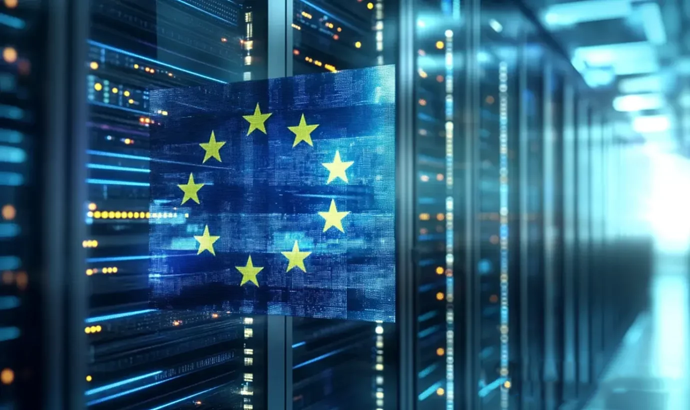
In a post-global world that is slowly taking shape, Europe is seizing the opportunity to reshape its role in the global tech race, this time in the data center and cloud computing space. As US hyperscale tech companies begin to slow down and the US becomes increasingly focused on domesticism, the European Union (EU) is building a more autonomous, sustainable and resilient data ecosystem than ever before.
🛑 The Retreat of the Superpower and the Space to Fill It
Conglomerates like Amazon Web Services (AWS), Microsoft Azure and Google Cloud have dominated the European cloud market for more than a decade. However, that “one-way” period is gradually coming to an end. As the US becomes increasingly inward-looking politically and commercially, Europe is starting to see the risks of over-reliance on foreign technology infrastructure.
The war in Ukraine, energy risks, and legal concerns surrounding the US CLOUD Act (which allows data to be retrieved no matter where it is stored) have woken up European policymakers. Now, the goal is not just to protect data, but to regain control of the digital economy.
🏗️ Bringing the data center home: Digital sovereignty reigns
The European Union is actively investing in its own data infrastructure:
The Gaia-X initiative is being pushed hard, aiming to build an open, decentralized, GDPR-compliant cloud platform.
Incentives are being offered to encourage businesses to store and process data in the region.
Foreign investment from Asia and the Middle East is pouring into Germany and the Netherlands, the EU’s data center hotspots.
At the same time, “giants” like AWS and Meta are forced to open local data centers to comply with the law, but Europe is no longer easily convinced by promises of “nominal sovereignty”.
🌐 Decentralization From a sideline to a mainstream trend
An interesting consequence of the “reclaiming data” wave is the growing interest in decentralized cloud solutions. Unlike the traditional centralized model, this model distributes data across thousands of nodes, helping to:
Increase resilience (to cyberattacks, political risks, natural disasters).
Improve access speed and latency.
Ensure flexibility and cross-border compatibility.
Nokia, once a mobile icon, is now a major investor in decentralized cloud platforms, signaling a dramatic strategic shift from the old guard.
🔄 Europe: From passive player to game-changer
Some experts are skeptical that Europe can match the scale of US corporations. But this ignores a key fact: quality and adaptability are replacing sheer size.
EU data centers are competing on equal footing on performance.
Modern cloud solutions are designed to connect, not divide, avoiding the fragmentation of the global Internet.
Flexible, transparent pricing models that are especially suited to startups, AI, and game studios are overshadowing the closed, expensive models of Big Tech.
Europe’s strategy is not just defensive, but to set a new global standard for cloud: open, resilient, and not easily shaken by foreign political changes.
⏳ The future is being rewritten by Europe
While the US turns to domestic priorities and Big Tech grapples with international law, the EU is embracing decentralization and regionalization as strategic weapons. If Europe succeeds in building an independent, transparent, and scalable data economy, it will prove that globalization is not about dependency but can be about sustainable connectivity based on sovereign choice.